Toastie Talk 26.02 – Building the Right Team Before Raising Funding
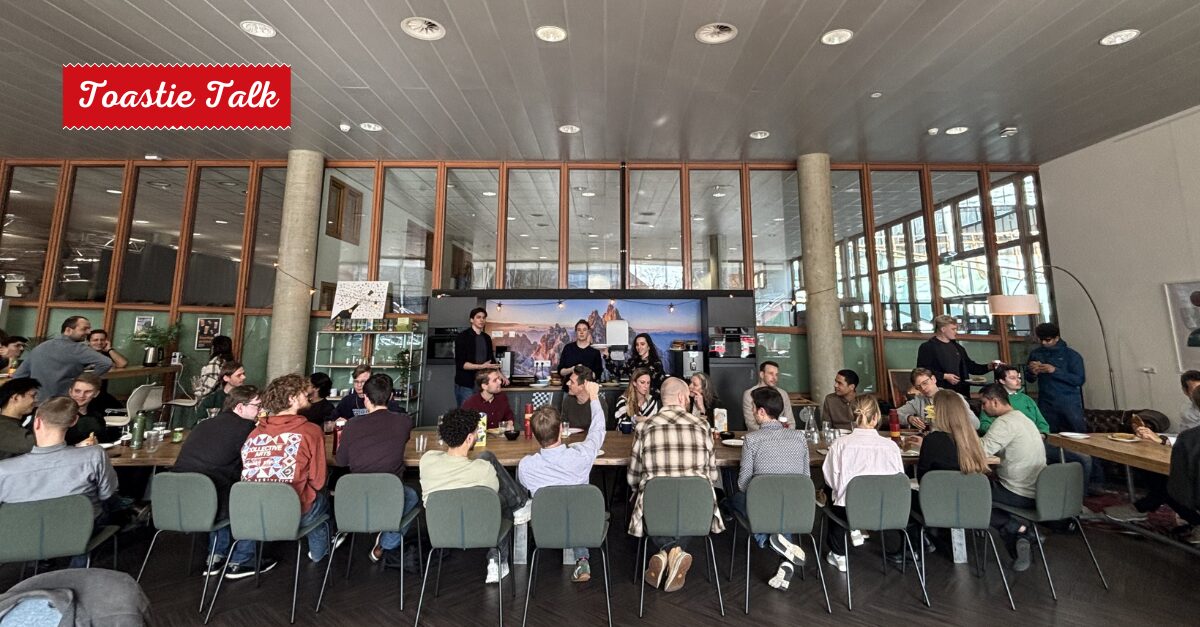
At our latest Toastie Talk, Robert shared an honest and practical story about building a startup team from the ground up — before funding, before scale, and before external validation.
The session focused on one central theme: team building and growth in the early stages of a startup.
Here are the key lessons.
1. Start With the Right Founding Team
“Being part of an incubator meant I didn’t have to do this alone.”
Shortly after joining an incubator, a third co-founder joined the team — a software engineer from industry. That addition created a strong complementary mix: applied science, computational expertise, and industry experience.
That combination made it possible to build an MVP within about a year.
Importantly, this happened without funding.
At that stage, external investors were not interested. Even later, closing funding rounds proved challenging. But because the founding team was strong and aligned, they were able to build a product that generated revenue before raising outside capital.
Lesson: A strong founding team can buy you time and independence.
2. Using Equity as a Strategic Tool
Equity has played a central role in attracting senior talent.
After closing their first pre-seed round, they hired a director who relocated from the US to Europe. For senior roles, equity is part of the compensation structure. The company uses Stock Appreciation Rights (STARs), a structure that is less complex than traditional stock options.
They are now formalizing equity for all employees and are transparent about it during recruitment.
Robert emphasized one practical point: good legal support matters and the UtrechtInc network helped significantly.
Lesson: Equity is not just a financial tool, it signals long-term commitment and shared ownership.
3. Hiring Philosophy: Mindset Over Skillset
One of the strongest themes of the session was hiring mistakes.
The biggest errors happened when technical skills were prioritized over mindset.
At one point, they had to let their first full-time hire go after the probation month. The lesson was clear: ignoring early “yellow flags” rarely works out.
Red Flags 🚩
- Entitlement
- Lack of accountability
- Projecting problems onto the employer
- Requiring constant supervision
- Focusing on individual achievement over team success
Green Flags ✅
- Strong generalists who can adapt as the company evolves
- Problem-solving mindset
- Ability to learn
- Team recognition and shared credit
- Clear communication
- Comfort with startup risk and transparency
Robert stressed that in early-stage startups, roles change quickly. Someone hired for one function today may need to adapt significantly within nine months.
Lesson: Skills can be developed. Mindset is harder to change.
4. Building Culture Across Disciplines
The team consists of applied scientists, software engineers, and computational biologists — people who do not always “speak the same language.”
To bridge that gap:
- Daily stand-ups
- Bi-weekly sprint meetings
- Dedicated science meetings
- Transparent Slack communication
Sales updates, trial progress, and technical challenges are shared openly. With a team of around ten people, transparency is essential.
5. Remote-First and Outcome-Focused
The company operates remote-first. Team members are based in Japan, Belgium, the UK, Switzerland and Slovenia.
They worked fully remote for three years before opening a physical office. Today, they operate hybrid.
They do not track hours. Instead, they track outcomes.
Bi-weekly sprints and clear KPIs keep everyone aligned. Meetings are intentionally limited (around four to five hours per week). To structure progress, they use “autonomy levels”, similar to self-driving car benchmarks, to define what percentage of datasets can be automatically analyzed.
Lesson: Clear goals reduce the need for micromanagement.
6. The Bigger Picture
If there was one overarching insight from the session, it was this:
- A strong founding team can outperform early funding.
- Equity should be intentional.
- Mindset consistently outweighs technical brilliance.
- Transparency builds trust.
- Culture must be actively designed.
Team building is not a one-time decision, it is an ongoing strategy.