Unlocking Mountain Water Data for Climate Resilience
There is no good data about water in mountains available; Hydrominds produces that data which helps to improve hydropower operations and helps investors and insurers to assess climate risks in mountains.
They are a climate-tech company that develops advanced tools and services to improve water resource management and disaster risk prediction in high mountain regions around the world.
They combine cutting-edge science, data and technology to deliver precise, data-driven insights on water availability, hydropower potential and climate-related risks. Their solutions such as their hydrological modeling platform help governments, businesses and organizations make better decisions around water, energy and climate resilience.
By turning complex mountain hydrology into actionable intelligence, Hydrominds supports sectors like agriculture, infrastructure and energy in becoming more efficient, resilient and prepared for the impacts of climate change.
Right now, their main focus is understanding the needs of the potential customer and obtaining initial funding.
About the team
Hydrominds was founded from a shared insight: the advanced models and data developed through years of mountain hydrology research could create far greater impact beyond academia. By taking a bottom-up approach, starting from real-world needs rather than purely scientific questions, the team is building practical tools for water management, hydropower and climate risk in mountain regions worldwide.
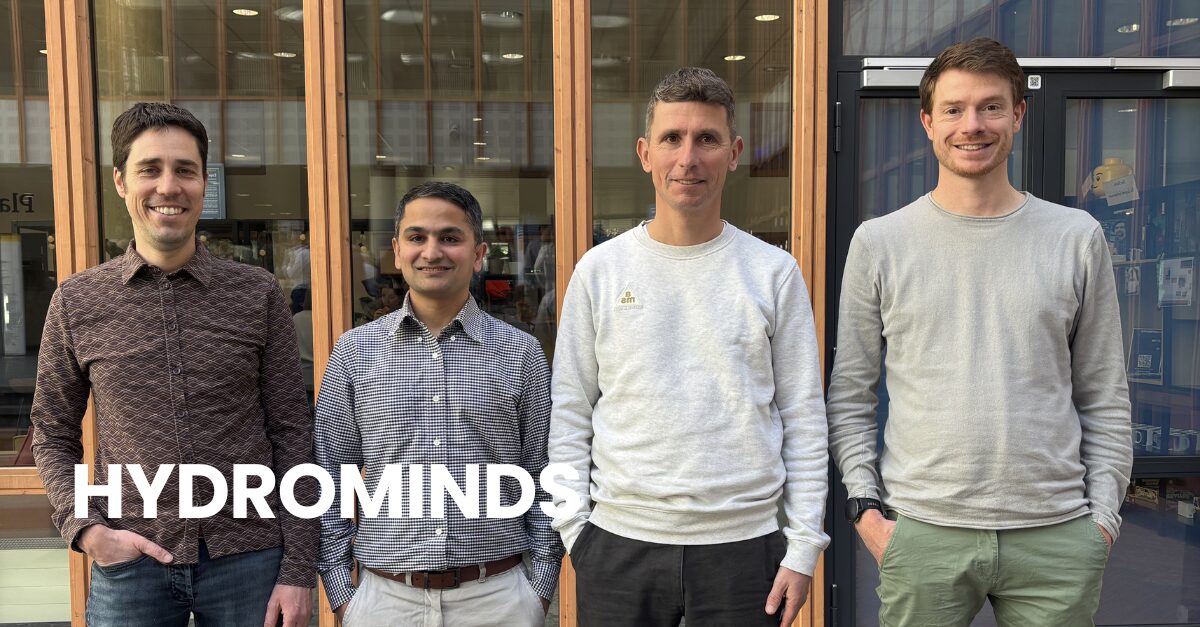
The founding team brings together deep expertise in climate science, hydrology and data-driven modelling. Sonu Khanal is a water resources expert and climate change specialist with over 14 years of global experience, leading projects on flood forecasting, drought risk, and climate resilience. Arthur Lutz, a hydrologist with 15 years of experience, focuses on mountain water systems and translates research into scalable, real-world solutions using advanced modelling, GIS and remote sensing.
They are complemented by Philip Kraaijenbrink, a physical geographer specializing in remote sensing, drone and satellite data, and large-scale environmental modelling, and Walter Immerzeel, a leading scientist and professor at Utrecht University with over 20 years of experience in climate change and mountain hydrology, recognized internationally for his pioneering research.
Together, the team combines academic excellence with hands-on project experience across Europe, Asia and Africa to develop impactful solutions for sustainable water management.
The founders, Arthur Lutz and Sonu Khanal answer some questions for us:
How does your background in (research field / discipline) shape the way you build this company?
We all have a background in research of mountain hydrology. Our shared passion for mountains is what has connected us over the last 10+ years, where some of us worked in academia and some in a small SME, but we always collaborated in one way or another. The background of working in an SME brings us good insights in how to run a small company, and also enables us to do some consulting work which enables us to self-fund our startup in the initial stages. Our research was at the highest level and now we also want to come up with the highest quality solutions for our clients.
What’s one early decision you’re glad you made even if it felt uncomfortable at the time?
For two of us one big decision was to quit our previous job completely to found hydrominds. This was a difficult decision to take, but also marked the start of this new adventure and enabled us to focus completely on the startup right from the beginning.
If things go well over the next 12 months, what would ‘progress’ look like for you?
If things go well over the next 12 months, we get some of the seed funding proposals we recently submitted, and have successfully piloted a first prototype of our solution with a hydropower company in Nepal. That should confirm that our value proposition is valid and we can move on from there. Ideally we are also able to expand the team by then to speed up things.